. It is learnt that 8 Congress MLAs will visit New Delhi and meet the party high command there. Some of DK Shivakumar’s close followers want a change in the Chief Minister in the state. Therefore, they are visiting Delhi repeatedly. They are meeting senior leaders and making demands. This is the third time in the past week that MLAs have gone to Delhi.
Meanwhile, while DK’s loyal MLAs are in Delhi, the Congress President is now in Bengaluru. He would have visited Delhi soon. But keeping in mind the growing political tension in the state, he has cancelled the visit. Because something is not going well in the Congress government. The internal turmoil in the party has now spilled out onto the streets and into the markets. Therefore, it is believed that he does not want to take risks. In the last three days, 10 Congress MLAs visited Delhi and met Kharge. They demanded that DK be made the Chief Minister in the state. Even though it has been two and a half years since the Congress government was formed, the demand for a change in leadership is increasing. DK was also questioned in this regard. He was ill and denied knowing anything about his supported MLA’s visit to Delhi.
Karnataka politics is currently witnessing a period of leadership change and internal strife, primarily within the ruling Congress party.
Here are some key developments that indicate how the political landscape could turn:
1. 👥 Chief Ministerial Tussle
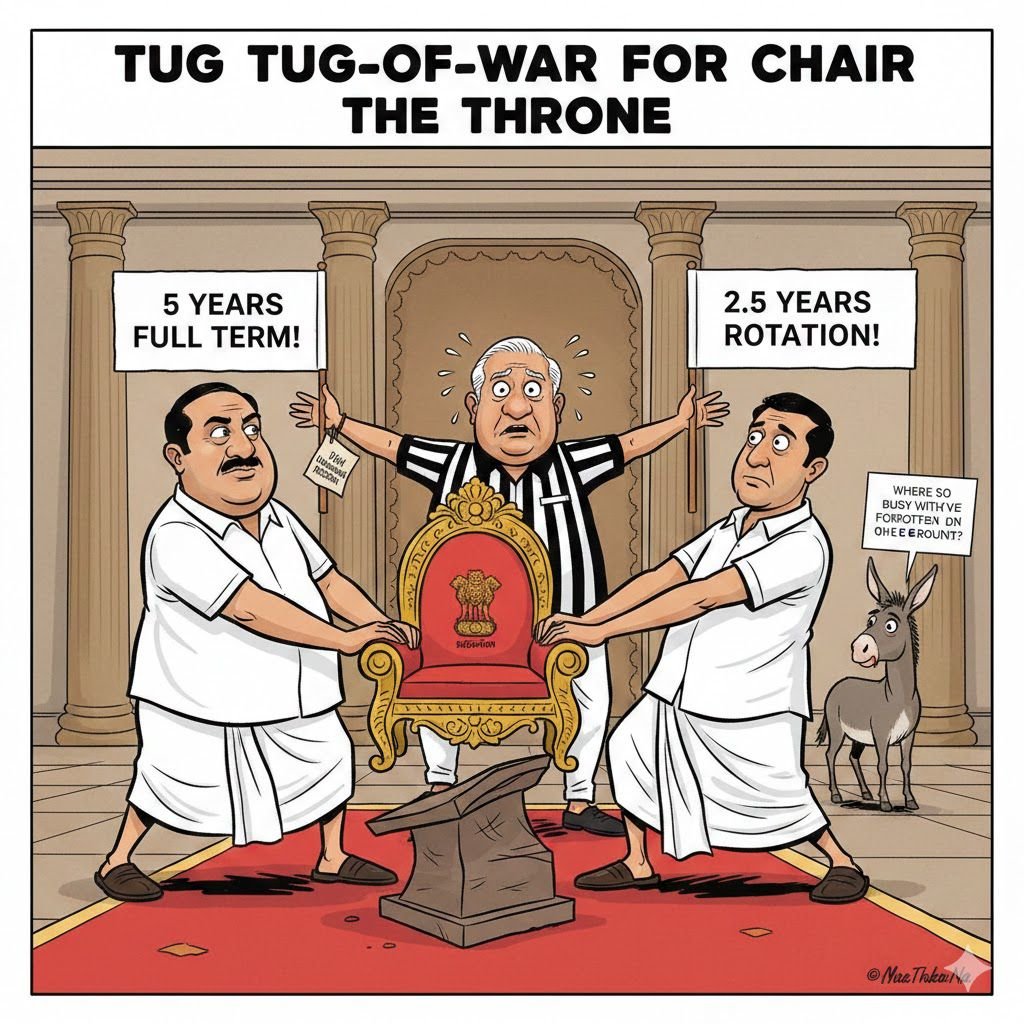
Siddaramaiah and D.K. Shivakumar: A tussle over the Chief Ministerial post is reportedly ongoing between Chief Minister Siddaramaiah and Deputy Chief Minister D.K. Shivakumar.
Two-and-a-half-year formula: There is speculation that an agreement was reached to share the Chief Ministerial post for two and a half years each after the elections, with Siddaramaiah’s first term reportedly completed. However, the party has never confirmed this.
High Command Decision: Both leaders have stated that the final decision will be taken by the Congress high command (Mallikarjun Kharge and Rahul Gandhi), and they will abide by it.
2. 🏛️ Other Leaders’ Claims and Lobbying
G. Parameshwara: Home Minister G. Parameshwara has also hinted at joining the race for the Chief Minister’s post, further escalating the tension.
MLA Lobbying: A group of MLAs supporting D.K. Shivakumar are meeting the Congress high command in Delhi, attempting to exert pressure on him.
3. 📉 Impact on Administration and Opposition Response
Administrative Instability: Opposition parties like the BJP and JDS are alleging that internal strife within the Congress has led to the collapse of the state administration and hampered development work.
BJP Prediction: BJP leader B.Y. Vijayendra and Union Minister H.D. Kumaraswamy have predicted unexpected and significant political developments in Karnataka.
4. 🔮 Possible Turning Points
Leadership Change: If the high command goes ahead with the ‘two-and-a-half-year formula,’ D.K. Shivakumar may become Chief Minister.
Cabinet Reshuffle: Siddaramaiah is pushing for a cabinet reshuffle. If the high command approves, it could signal that Siddaramaiah will complete his full term (5 years).
Instability: Internal strife and factionalism are damaging the government’s image, which could be exploited by opposition parties.
1. Public Opinion on the Political Tussle
Generally, public opinion and media coverage are viewing this tussle negatively. The following are the major concerns:
⛔ Damage to Governance: People and analysts believe that the ongoing power struggle between the two top leaders (Siddaramaiah and D.K. Shivakumar) is affecting administrative stability. Development files are stuck, and the government’s focus is primarily on internal strife.
📉 Impact on Development: The opposition and many analysts allege that the government is neglecting important issues like infrastructure and law and order in the fight for the CM post.
❓ Fear of Broken Promises: There is a feeling among a section of the public that if the high command reneges on the alleged two-and-a-half-year agreement, it will raise questions about the party’s credibility.
💰 Allegations of corruption and quid pro quo: Opposition leaders (such as Prahlad Joshi) are openly alleging that both factions are engaging in horse-trading to secure the support of MLAs, tarnishing the image of state politics.
🚨 Damage to image: This public tussle is denting the image of the Congress party, as it sends the message to the public that personal power is more important to the leaders than public service.
2. 🎯 Opposition’s Strategy
The state’s main opposition party, the Bharatiya Janata Party (BJP) and its alliance partner, the Janata Dal (Secular) (JDS), are employing a strategy to take full advantage of this internal strife:
⚡ Alleging instability: The opposition has consistently alleged that the Congress government has effectively split into two factions and governance has completely collapsed. They are calling this situation the “darkest period” in the state’s political history.
🔎 Repeating the “two and a half years” question: Opposition leaders are repeatedly asking the high command whether a power-sharing agreement was reached. By deliberately raising this question, they are pressuring the Congress and creating confusion.
🤝 Strengthening the BJP-JDS alliance: Both parties (BJP and JDS) are now working together under the National Democratic Alliance (NDA). Their strategy is to strengthen the alliance at the grassroots level, following the Bihar model, to challenge the Congress in upcoming elections (such as local body elections and the 2028 assembly elections).
Coalition Committees: They have decided to form coordination committees to corner the government on local elections and other issues.
📢 Prediction of a major political event: Opposition leaders, such as H.D. Kumaraswamy and R. Ashoka, have publicly predicted ‘unprecedented political developments’, sending the message that the government could fall or become unstable at any time.
In essence, the opposition is treating this internal strife as a gift and trying to gain public confidence by presenting it as evidence of administrative failure and the party’s decline.