The war in West Asia has now entered its third week, and there are no signs of it stopping in the foreseeable future.
In the meantime, Finland’s President Alexander Stubb has appealed to India to take the initiative for a ceasefire between the US-Israel and Iran.
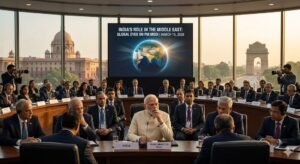
The President of Finland is not alone. Earlier, Colonel Douglas McGregor, considered an influential voice in American politics, described Prime Minister Narendra Modi as a leader who could mediate to stop this war.
He stated that India is a neutral country whose strength, stature, and influence are growing. Only such a country can mediate in this conflict. Diplomat Hussain Hasan Mirza, who served as the UAE Ambassador to India, has also expressed similar views.
Let’s understand why the world sees India as the most suitable country capable of mediation.
Accelerating the Pace of the Economy
……………………………………………………………………
Global Stature: India’s economy suffered a major blow during the COVID-19 pandemic. Its growth turned negative in the financial year 2020-21. However, India made a swift recovery after that. In the December 2025 quarter, India’s GDP grew by 7.8 percent. A growth of approximately 7.6 percent is expected in fiscal year 2026.
According to the International Monetary Fund (IMF), India is one of the fastest-growing major economies in the world. Notably, while the economies of the US, China, and the EU were slowing down, India was advancing rapidly. This pace of growth continues despite the Russia-Ukraine war and uncertainty in global trade.
Factors in favour of India to meditate –
1 – India’s Growing Economic Power
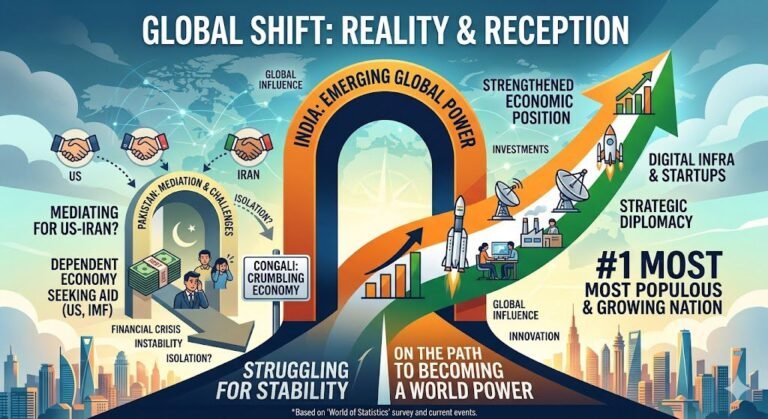
2- 17 percent: India’s contribution to global GDP growth.
3- 26.6 percent: China will remain in first place in 2026.
4- 9.9 percent: The US will be in third place in terms of contribution.
5- Advantages of Economic Power According to the IMF
6- Strong military
7- Better technology
8- Increased trade
9- Greater global influence
10- India is Not Tied to Any Bloc
11- India’s specialty is that it maintains good relations with all countries:
12- Strong defense ties with Israel.
13- Long-standing cultural and trade relations with Iran.
14- Strategic partnership with the USA.
This is why India can become a trustworthy mediator.
1- India can talk to all parties.
2- Strategic autonomy is the strongest foundation of India’s foreign policy.
3- Instead of joining any bloc, India takes decisions based on its own interests.
4 – India also holds the legacy of the Non-Aligned Movement.
Limitations of Other Countries –
1- China: Considered to be on the side of Iran.
2- Europe: Close to the United States.
3– Gulf Countries: Themselves entangled in the war.
…………………………………………………………………..
Here is a summary of the most recent international reactions and diplomatic developments regarding India’s role as a potential mediator as of today, March 19, 2026:
1. Calls for Mediation from Global Leaders
Finland’s President at Raisina
Dialogue: During his visit to India earlier this month for the Raisina Dialogue 2026, President Alexander Stubb explicitly stated that the Western-led global order is weakening and that “New Delhi has the trust of both sides.” He urged PM Modi to use India’s unique diplomatic standing to secure a ceasefire.
US Political Influence: Retired US Army Colonel Douglas Macgregor recently suggested on a high-profile podcast that PM Modi is the “best-suited” leader to mediate. He emphasized that India’s status as a “growing neutral power” makes it a credible “off-ramp” for de-escalation that Western nations cannot provide.
Gulf Perspectives: Former UAE Ambassador to India, Hussain Hasan Mirza, echoed these sentiments, suggesting that “a single call from PM Modi” to the leaders of Israel and Iran could be the catalyst needed to halt the hostilities.
2. PM Modi’s Proactive “Telephone Diplomacy”
Within the last two weeks, PM Modi has initiated a massive diplomatic outreach to secure regional stability:
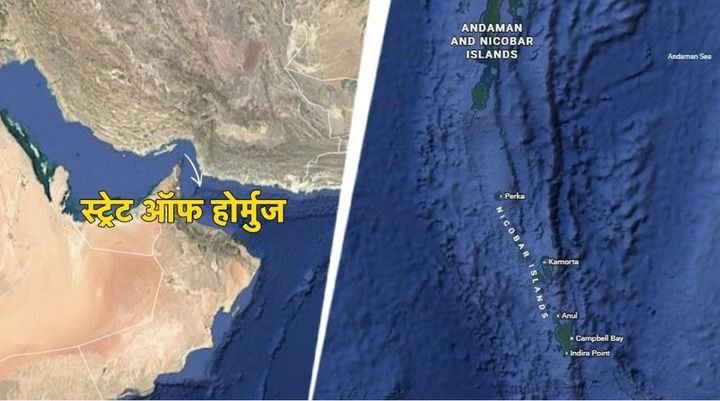
Gulf Leaders: He held separate conversations with leaders from Saudi Arabia, the UAE, Qatar, Oman, Kuwait, and Bahrain. The primary focus was the safety of the nearly 10 million Indian expats in the region and ensuring the Strait of Hormuz remains open for global energy supplies.
Direct Contact with Combatants: PM Modi has also been in contact with Israeli PM Benjamin Netanyahu and Jordanian King Abdullah II to advocate for immediate dialogue.
3. Why India is the “Only Bridge” Right Now
International analysts are highlighting a few specific reasons why India is being singled out over other powers like China or the EU:
The “Vishwa Mitra” Stature: India is currently the only major power that maintains a “Special Strategic Partnership” with Israel while simultaneously holding deep institutional trust with Iran (evidenced by the long-term Chabahar Port agreement).
Strategic Autonomy: Unlike China, which is often viewed by the West as being tilted toward Iran, or the EU, which is tied to the US position, India’s “interest-based” foreign policy allows it to talk to all factions without being seen as a proxy.
Current Conflict Status (March 19, 2026)
The situation remains critical. Overnight, reports surfaced of fresh strikes in Tel Aviv and retaliatory actions against Iranian leadership. While China has also offered to mediate, many Western and Gulf experts believe India holds the “psychological and strategic leverage” required to actually bring both sides to the table.