
A land of disappeared people
Watch the video below
…………………………………………………………………….
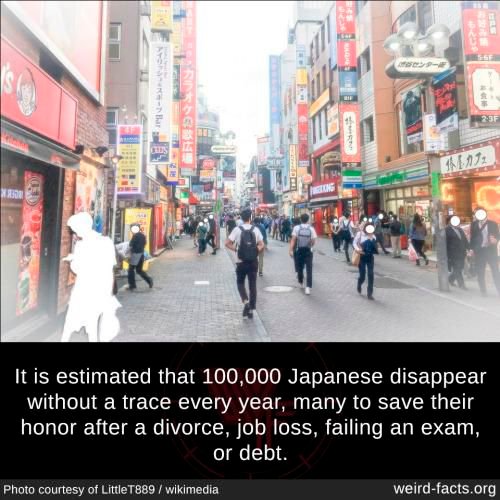
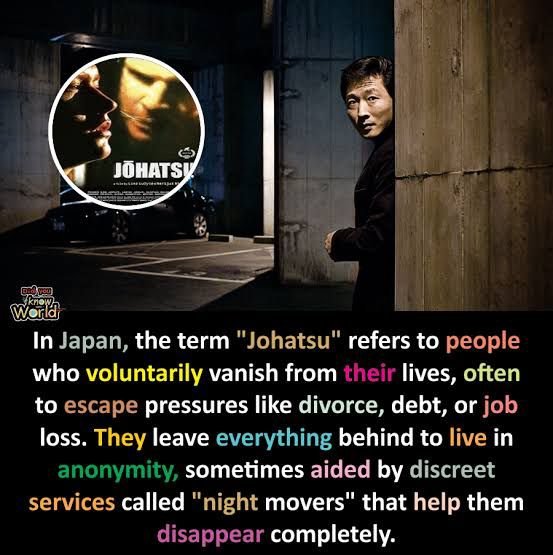
Every year, thousands of people in Japan disappear, seemingly vanishing into thin air. They leave behind their families, careers, debts, and in many cases, their entire identities. This is called johatsu, which means “to evaporate.” These individuals make the decision to disappear from society, often due to overwhelming pressure, personal failures, or the anxiety of starting a new life.
This is different from typical disappearances. Here, crime or accident is not the motive; rather, it is often a deliberate, intentional act.
A Cultural phenomenon based on shame
The term “johatsu” was used to describe people who disappeared during the economic hardships in Japan after World War II. Today, the term refers to a broader social phenomenon: men and women who remove themselves from society due to financial ruin, family breakdown, academic failure, or mental problems.
In a collectivist society like Japan, where personal failure is considered a disgrace not only for the individual but for the entire family, the social pressure becomes unbearable. As a result, many choose silence over confrontation, and anonymity over humiliation.
Common reasons for becoming a johatsu include:
Job loss, bankruptcy, or heavy debt
Divorce, domestic violence, or estrangement from family,
failure in student entrance exams
mental illness and lack of support,
escaping from the yakuza (crime syndicates) or debt collection.
How do people disappear in a surveillance society?
Japan is known for its high-tech surveillance, national identification system, and strict record-keeping. Yet, how do thousands of people disappear every year? The answer lies in “yonige-ya” (night-movement companies). These secret services help those who want to leave their lives overnight. They take people and their belongings quietly, without asking any questions. Legally, this is a gray area, but not entirely illegal.
According to a 2017 Time report, yonige-ya services often cost between 50,000 yen and 300,000 yen (approximately 400–2,500 US dollars), depending on the complexity of the disappearance. Many end up in marginalized areas like Sanya in Tokyo or Kamagasaki in Osaka, where identity checks are less stringent and temporary labor is more readily available.
Impact on Families Left Behind
For the loved ones left behind, these disappearances bring profound grief, confusion, and financial hardship. Legal proceedings remain incomplete, and families cannot declare the missing person dead or settle their property. Emotional suffering is a separate issue.
Many families face social shame and ostracism (known in Japan as murahachibu, or “village banishment”).
Many families don’t even report a missing person for fear of social shame and ostracism (known in Japan as murahachibu, or “village banishment”). This deep-rooted social fear fuels both disappearances and the lack of retrieval.
Not a rebellion, a silent last resort
For many, johatsu is not a rebellion but a last resort against a society that seems unwilling to give a second chance. Some return after years, and their families silently accept their absence. Others remain anonymous for life.
Journalists and photographers—such as Leo Rubinfein (Wounded Cities) and Lena Moger and Stefan Remel (The Vanished)—have studied this phenomenon. It is estimated that approximately 100,000 people attempt to disappear voluntarily in some way each year in Japan.
About the Author