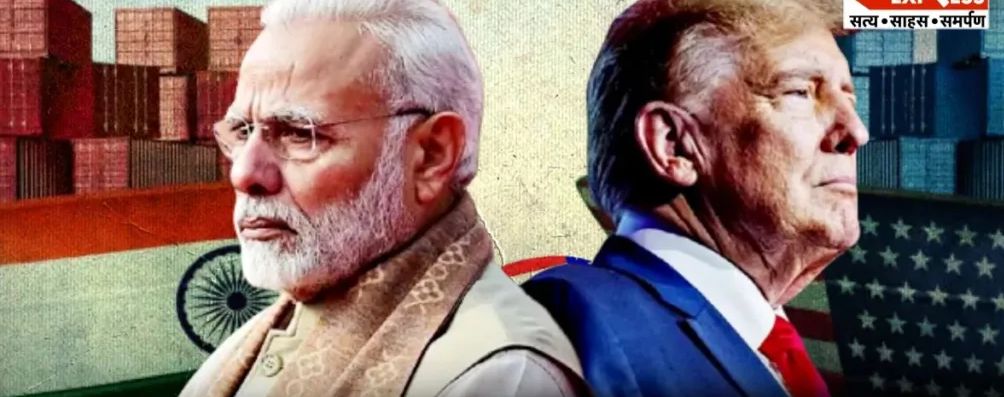
The friendship between US President Donald Trump and India’s Prime Minister Narendra Modi, the world’s most popular leader, began in 2016 with great events, which brought them closer on the world stage. But issues like Pakistan, the Nobel dispute and the trade war have created tensions in this friendship and taken it to the extreme. Trump’s “America First” policy and India’s economic decisions increased tensions, but now India is managing relations with the US by adopting a balanced strategy and playing an independent global role.
The relationship, which was called an “example of friendship” through events like Howdy Modi and Namaste Trump, has now sunk into the depths of tension and distrust. The recent spat between former US President Donald Trump and Indian Prime Minister Narendra Modi has shown how quickly personal intimacy can turn into political and diplomatic confrontation.
A phone call and growing tensions
A phone call on June 17 changed the course of relations between the two leaders from East to West. Trump has repeatedly claimed that he has “ended” the India-Pakistan war, for which he should be awarded the Nobel Peace Prize.
But Modi has made it clear that the US had no role in the ceasefire. India and Pakistan had resolved the issue directly at their level. Trump had hoped that Modi would support his “Nobel campaign”, but this did not happen. From here the rift began to widen.
It is not that Prime Minister Modi did not know that Trump wanted to win the Nobel Prize. He knew it well. If he ignored his old friend, then what was the reason?
If Modi had given Trump a chance to mediate in this matter, it would have been considered a weakness in his domestic politics. The opposition would have surrounded him like a hawk. In addition,
Indian foreign policy has a “no third party mediation allowed”. This principle is the basis of India’s foreign policy. That is why Modi rejected Trump’s Nobel wish.
Tariffs and allegations of ‘hooliganism’
Just a week after the Nobel controversy, the Trump administration imposed a 25% tariff on India and then an additional 25% tariff on oil purchased from Russia. The total tariff of 50% proved to be an economic disaster for India.
In India, this was called “hooliganism”. An effigy of Trump was burnt in Maharashtra, with the words “stabbed in the back” written on it.
The relationship is complicated: From visas to trade
It is not just tariffs, but many other issues have also damaged the relationship, such as:
Ban on H-1B and student visas: Direct impact on Indian IT sector and students.
US crackdown on immigration: Domestic anger over sending Indian expatriates back to India in handcuffs, stalled trade talks and US calling India’s stance arrogant, all these incidents have created a rift in India-US relations.
Is Modi leaning towards China and Russia?
Modi, dissatisfied with Trump’s policies, now seems to be leaning towards China and Russia. His meetings with Xi Jinping and Vladimir Putin this weekend indicate this.
Modi is now once again emphasizing “Self-reliant India” and Make in India, as if to reduce dependence on America.
India has other options too.
This story of Trump-Modi relations is not just about the stubbornness and arrogance of the two leaders, but it is also a vivid example of how complex and fleeting personal equations are in international politics.
The two leaders, who once held hands and interacted with each other in a friendly manner, are not even talking to each other today. And the economic and military relations of the two countries are paying the price.
About the Author