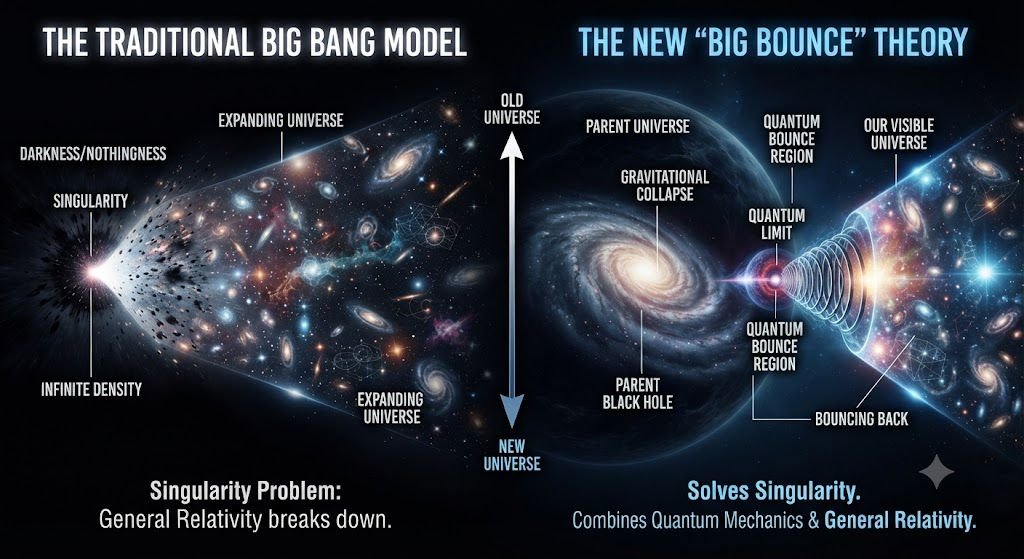
Analysis by Jawahar Mishra is given below
……………………………………………………………………….
. According to recent research published in leading science journals such as Physical Review D, international scientists have presented a new theory regarding the origin of the universe. According to a report by MSN.COM, this new study suggests that the beginning of our universe may not have been caused by the traditional ‘Big Bang’, but rather by a ‘Big Bounce’ process.
………..
Key Scientific Facts and Discoveries
…………………………………………………………..
The Singularity Puzzle – The older ‘Big Bang’ theory posited that the universe originated from an extremely small point of infinite density. However, scientists acknowledge that at that specific point, Einstein’s general laws of physics (General Relativity) cease to function.
…………
What Is the ‘Big Bounce’ Theory ?
…………………………………………………………..
According to the new study, the universe did not originate from any void or microscopic singularity. Instead, an older universe gradually underwent gravitational collapse. When matter compressed fully to its quantum limit, it did not disintegrate due to the laws of physics; rather, it bounced back like a spring and began expanding.
……….
Black Holes and the Parent Universe Model
………………………………………………………..
According to Professor Enrique Gaztañaga and his team from the University of Portsmouth, our entire visible universe could be the result of a gravitational bounce occurring inside a massive black hole of a larger ‘parent’ universe.
……….
Merging Quantum Mechanics and Einstein’s Rules –
This new model aligns with the principles of both quantum mechanics and general relativity, resolving the complication of ‘infinite density’ (Singularity).
………..
Has the ‘Big Bang Theory’ Been Proven Entirely Wrong?
…………………………………………………………..
No. From a scientific perspective, this does not dismiss the Big Bang theory; rather, it represents a major refinement (Expansion Model) within it. This study does not negate the expansion of the universe; instead, it accurately explains what transpired right before the expansion commenced.
…………..
Analysis: Validity of the New Study
…………………………………………………………..
This new ‘Big Bounce’ or ‘Black Hole Universe’ model introduced by Professor Enrique Gaztañaga and his team is neither entirely ‘wrong’ nor an absolute final word, but it addresses one of the most stubborn paradoxes in modern astrophysics: the Initial Singularity.
………..
The Strength – In traditional cosmology, the mathematical breakdown at a singularity signals where General Relativity fails. By incorporating quantum limits and showing how matter can rebound at ultra-high densities (akin to neutron degeneracy or nuclear saturation), this theory offers a mathematically testable framework without needing unproven speculative inputs like inflation fields or arbitrary dark energy parameters.
…………
The Limitation- While it elegantly bypasses the absolute creation out of a mathematical zero-size point, it shifts the origin question outward—asking where the ‘parent universe’ or the initial collapsing cloud came from. Science treats it as a progressive model rather than a complete rejection of cosmic expansion, as observational milestones like the cosmic microwave background remain consistent with post-bounce expansion.
…………
Vedic Philosophy, Cosmology, and Modern Theories
…………………………………………………………
When examining cosmic creation through the lens of ancient Indian Vedic literature and Siddhantas, striking parallels emerge with cyclical models of the universe rather than a one-time linear creation:
Cyclical Creation (Srishti and Pralaya): Vedic cosmology conceptualizes time and creation as eternal cycles (Kalpas and Yugas). The universe undergoes endless loops of manifestation (Srishti) and dissolution (Pralaya). There is no absolute linear beginning or permanent end, which philosophically aligns closely with the concept of a ‘Big Bounce’—where a prior state collapses only to re-emerge into a new phase of expansion.
………….
Nasadiya Sukta (Rigveda): The famous creation hymn of the Rigveda questions the absolute state before creation, noting that neither non-existence nor existence was there initially, pointing to a profound underlying cosmic order rather than a random explosion out of absolute nothingness.
……..
Comparison with Big Bang vs. Big Bounce:
…………………………………………………
The standard linear Big Bang implies a strict chronological start from a single point, which sits somewhat differently against eternal cyclical doctrines. In contrast, the Big Bounce model—with its eternal rhythm of inward gravitational collapse (Pralaya) and outward rebound/expansion (Srishti)—resonates much more harmoniously with the dynamic, cyclical vision of cosmology described in the Vedas and Vedantic texts.
About the Author