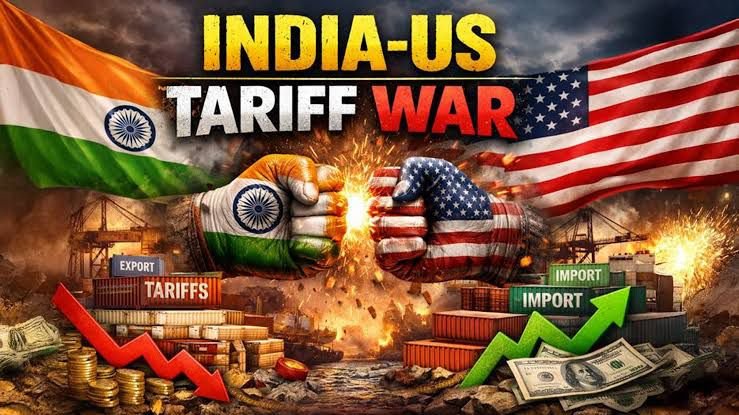
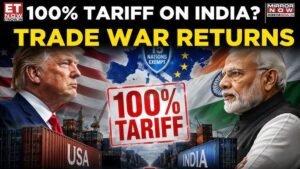
Summary – The proposed 100% tariff bill by the US Senate has raised concerns for India. If enacted, it could impact oil imports from Russia, rupee-ruble trade, and defense deals. Additionally, a major threat looms over Indian exports to the US. Balancing ties between Russia and the US will be India’s biggest challenge.
……………………………………………………………………….
Details – The US Senate has advanced a new bill to increase economic pressure on Russia. The proposal states that if any country uses its local currency, such as rupee-ruble, instead of the US dollar to trade with Russia or attempts to bypass US sanctions, the US can impose up to a 100% tariff on goods coming from that country. However, this bill has not yet become law. It requires approval from the US House of Representatives and the President before implementation. Despite this, the proposal has heightened concerns for several nations including India, alongside China, Slovakia, Hungary, and Azerbaijan.
………………..
Following the Ukraine war, the US and Western countries imposed numerous economic sanctions on Russia. In response, Russia, China, India, and several BRICS nations began increasing the use of local currencies instead of the dollar in mutual trade. The US views this as a challenge to the global strength and financial influence of the dollar. Therefore, it is preparing to ramp up economic pressure on countries trading with Russia in non-dollar currencies.
……………….
Why Might India Be Affected the Most ?
……………………………………………………………………….
India and Russia share long-standing strong strategic and economic relations. Consequently, this proposal could emerge as a challenge for India on three major fronts.
……………..
1. Cheap Crude Oil from Russia
……………………………………………………
Following the Ukraine war, India began purchasing large quantities of Russian crude oil at discounted rates. Today, India imports approximately 35 to 40% of its crude oil requirements from Russia. This has helped keep energy costs down. However, if the US takes strict action on this basis, purchasing oil from Russia could become expensive for India.
…………..
2. Rupee-Ruble Payment System
……………………………..
After Russia was excluded from the SWIFT international payment system, India and Russia established a mechanism for payment in rupees and rubles through Vostro accounts. The US Senate’s new proposal targets such non-dollar payment systems, which could disrupt trade between the two nations.
…………….
3. Defense Deals
………………………………
About 60 to 70% of the military equipment in the Indian armed forces is of Russian origin. Major defense agreements, including the S-400 air defense system, are with Russia. Stricter sanctions could create difficulties in payments, maintenance, and future defense deals.
………………
4. The Biggest Challenge for India
…………………………………………………………………………………………………………
Both Russia and the US are extremely crucial partners for India. India’s bilateral trade with the US is around $120-130 billion, with India holding a trade surplus of $34.41 billion. Meanwhile, trade with Russia is around $60-65 billion, a large portion of which is tied to crude oil imports.
……………..
If the US imposes a 100% tariff on Indian products, major export sectors such as Indian IT, pharma, textiles, engineering, and gems & jewelry could suffer a severe blow. Indian goods would become expensive in the US market, leading to a drop in demand.
…………….
Test of Strategic Autonomy
…………………………………………………………………………………………………………
Experts believe this is not just a matter of trade, but also of India’s strategic autonomy. Earlier too, the US had threatened to impose sanctions on India under the CAATSA law regarding defense purchases from Russia, but considering India’s strategic importance, strict steps were not taken. This time, the matter is also linked to global efforts to seek alternatives to the dollar, which is why India must strike a balance between energy security and trade relations with the US.
……………..
What Might Happen Next ?
…………………………………………………………………………………………………………
Currently, this is only a proposed bill and several stages remain before it becomes law. However, it has posed a major question for India on how to maintain a balance between buying cheap oil from Russia and preserving its largest export market, the US. In the future, the biggest test of Indian diplomacy will be how it protects its national interests with both Moscow and Washington.
About the Author