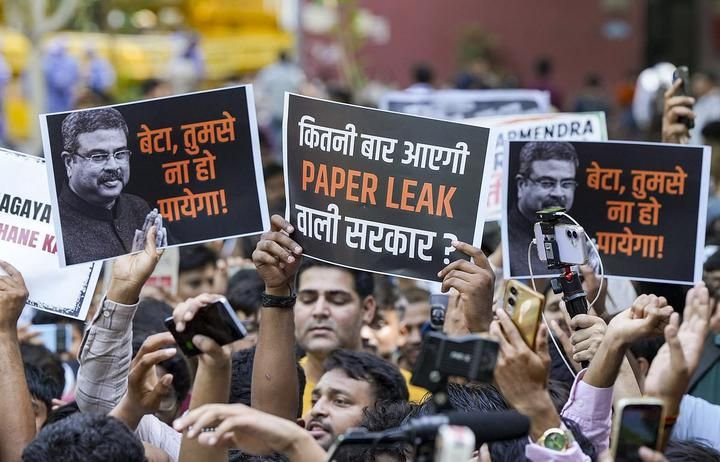
The national capital, Delhi’s Jantar Mantar, became the epicenter of significant social and political tension on Saturday. The frustration of the youth was evident against the regular errors, irregularities, and alleged corruption seen in the examination system across the country. Thousands of young men and women, gathered under the banner of the ‘Cockroach Janata Party’ (CJP), opened a front directly demanding the resignation of Union Education Minister Dharmendra Pradhan.
The protesters have issued a seven-day ultimatum to the central government, demanding the intervention of the Prime Minister and the dismissal of the Education Minister. This controversy has intensified further after the ‘5 PM deadline’ set by the organization’s founder, Abhijit Dipke, for the Education Minister’s resignation passed without success.
The party’s spokesperson, Ashutosh Ranka, described this as merely a ‘trailer’ and warned the government that if no strict action is taken within seven days, the movement will move out of Delhi and spread across the country. Abhijit Dipke has made serious allegations, stating that the government is busy hacking the social media accounts of students and suppressing their voices instead of resolving their problems.
On the contrary ,The ‘Cockroach Janta Party’ (CJP) has become embroiled in controversy following a large-scale protest at Jantar Mantar against the alleged NEET-UG 2026 paper leak and irregularities in the CBSE on-screen marking (OSM) process. A complaint has been filed against the organization, alleging anti-national activities and the receipt of foreign funding.
This complaint has surfaced at a time when thousands of students, young professionals, and supporters gathered at Jantar Mantar on Saturday under the leadership of CJP founder Abhijeet Deepke. A large number of youths participated in the demonstration, carrying posters and banners to demand transparency in the examination system.
Abhijeet Deepke recently returned from the United States. The complaint alleges that the campaign led by him might be influenced by foreign funding. However, no official response has been issued by the organization regarding these allegations thus far.
What ever it may be, now the million-dollar question is: Will this movement take the form of a massive agitation in the future ?
Analysis
……………………..
Analyzing this entire sequence of events, it becomes clear that it carries all the potential to move towards a large-scale agitation. This depends on the government’s approach towards the protesters’ demands in the coming time. When a local movement takes a comprehensive form, it contains certain specific elements, such as :
Transparency in Leadership – When a movement moves beyond group interests and connects with the fundamental problems of the public, such as unemployment and corruption, it becomes acceptable.
Emotional Connection – When every student feels they are a part of this fight, it turns into a mass movement.
Administrative Response – If the government does not take any repressive action, the movement might not become aggressive or take on a massive form. This depends on the government’s wisdom.
Furthermore, the future of this movement, amidst hope and apprehension, depends on its ‘credibility.’ If this movement does not remain limited to social media , but creates organized pressure at the grassroots level, it can certainly change the political equations in the days to come.
Fifteen years ago, Anna Hazare’s movement in Delhi turned into a mass movement because the radiant personality of Anna Hazare, who led the movement, attracted the public. The current leader, Abhijit Dipke, lacks these attributes. The scale of the movement depends on how attractively Abhijit presents himself to attract the public moving forward.
If the public feels that the voice of protest is not being heard, they may support the movement themselves, which could become a major challenge for the ruling group. Therefore, it would be a wise move for the government to resolve the causes of this movement before it takes a massive form.