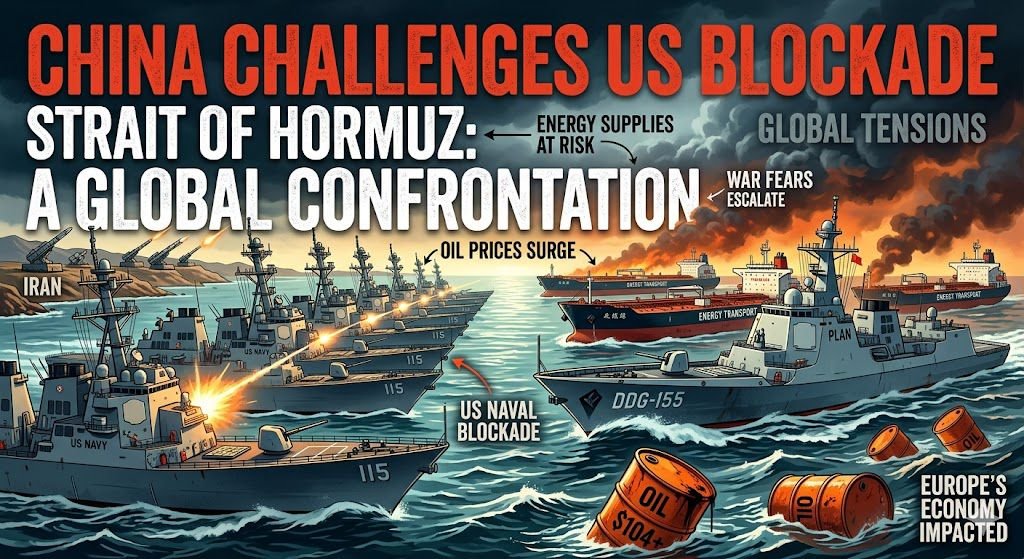
The American blockade of Iranian ports has deeply unsettled China. China has now directly warned the United States in clear terms not to interfere in its affairs. This tension escalated further when Chinese ships were forced to return midway from the Strait of Hormuz. In fact, after the failure of discussions between Iran and America in Pakistan, President Donald Trump issued strict orders for the blockade of this maritime route, following which the situation has become critical.
Why did China challenge America ?
China’s Defense Minister, Dong Jun, has clarified Beijing’s stance on this issue. He stated that China desires peace in the region but will not back down from its energy and commercial agreements with Iran. China has explicitly stated that it will not tolerate the interference of any third country in its trade interests. China believes that Iran has complete control over the Strait of Hormuz and this path should always remain open for Chinese ships.
The Chinese Defense Minister further added, “Our ships are constantly moving through this maritime route. We have long-standing oil and energy agreements with Iran, and we will honor them under any circumstances. We hope that other countries (America) will not create obstacles in our work.”
Growing Discontent Across the Globe
Not only China but many other countries are dissatisfied with this move by the United States. Spain’s Defense Minister, Margarita Robles, described the blockade as “senseless,” stating that such decisions have already pushed the world to a dangerous turning point. Similarly, Australian Prime Minister Anthony Albanese clarified that he has received no invitation to join this blockade. He emphasized that this waterway should remain open to all countries for international trade.
Fuel Prices on Fire
As soon as the US-Iran talks failed and the blockade was announced, a stir was created in the global market. A massive surge has been witnessed in crude oil prices. While Brent crude crossed $101.88 per barrel, US crude reached up to $104.69 per barrel. According to experts, if the tension regarding the Hormuz issue does not subside, there will be intense instability in the energy market in the coming days, the impact of which will fall directly on the pockets of the general public.
Iran and America on the Brink of War
Iran has also threatened to give a stern response to this American siege. Iran warned that it could target all ports in the Persian Gulf and the Gulf of Oman. This has created a fear of war breaking out in the region once again. Meanwhile, the ‘United Kingdom Maritime Trade Operations Agency’ has issued an alert for sailors. The notice states that the blockade involves the entire Iranian coast. Although there are currently no restrictions on the movement of non-Iranian ships, they may face a heavy military presence and inspections at sea.
Yemen’s Houthi rebels could target the Bab-el-Mandeb Strait, which connects the Red Sea to the Indian Ocean. About 12 percent of the world’s oil and 10 percent of global trade pass through here. If this route is also affected, oil supplies to Europe could come to a near standstill.
Europe Most Affected
Europe already appears to be the most affected by this crisis. It may have to find alternative routes for oil coming from the Gulf, which will increase cost, time, and inflation. Ships will have to take the long route around Africa, which will also impact the global supply chain.
Overall, the blockade of Hormuz is no longer just a regional strategy; it could become the beginning of a global confrontation in which energy, trade, and major powers all appear entangled together.
The Chinese Defense Minister has clearly stated that no interference in their trade and energy agreements will be tolerated. In such a situation, if the U.S. tries to stop Chinese ships, this confrontation could turn directly into a U.S.-China conflict. The U.S. has already warned that if China provides weapons to Iran, it will have to pay a heavy economic price.
China May Adopt Grey Zone Strategy
Experts believe that China will not enter directly into war, but it could adopt a “Grey Zone” strategy. In this, it could stop the supply of critical products like rare minerals and semiconductors, which would deal a major blow to the economies of Western nations. Along with this, China could also make the situation more complex by increasing military pressure in Taiwan or the South China Sea.
The situation on the energy front is also extremely serious. China sources a large portion of its total oil requirements from Gulf countries and Iran. A deepening crisis in Hormuz means there will be a direct impact on global oil supplies, which could lead to a massive surge in prices.