( An AI’ s analysis is given below)
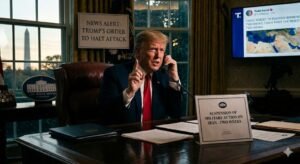
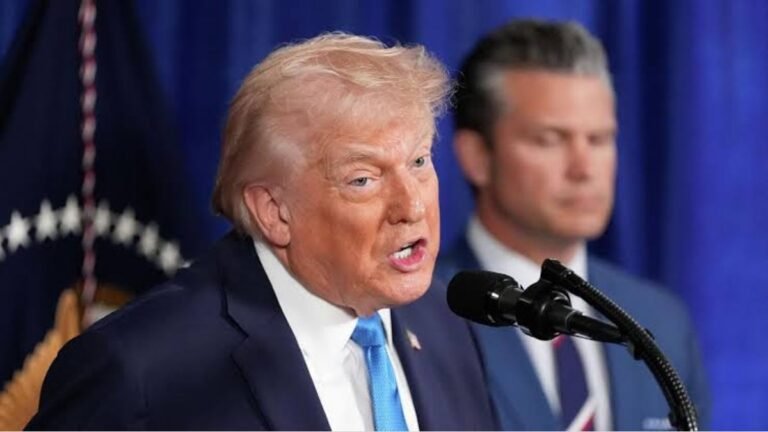
Amidst the rising tensions between the US and Iran, US President Donald Trump has suddenly changed his stance and announced a temporary halt to military action for the time being, appearing to open a potential path for a diplomatic solution.
Posting on ‘Truth Social’, Trump stated, “I have agreed to suspend bombings and attacks on Iran for two weeks,” and described it as a step toward a broader ceasefire.
He mentioned that this decision was taken after discussions with Pakistan’s Prime Minister Shehbaz Sharif and Army Chief Asim Munir, who had appealed to avert the proposed strikes.
Trump also clarified that this pause is conditional; Iran must reopen the ‘Strait of Hormuz’, which he termed as a necessary step to reduce escalation. He wrote, “This will be a bilateral ceasefire,” implying that both sides are expected to back down during these two weeks.
Intense Strikes on Iran
The events prior to Trump’s announcement of the suspension—as Trump’s deadline for attacking Iran approached, Israel and the US intensified their strikes. The Iranian government has halted train services on several routes. Reports suggest attacks on highway bridges, and several large bridges are being blown up. Trump’s “Power Plant Day” and “Bridge Day” threats now seem to be taking a practical shape.
According to reports, three bridges in Iran have been attacked. A bridge built on the Tabriz-Zanjan highway in northwestern Iran was blown up. Iran’s state news agency, IRNA, quoting an official, reported that an attack on a railway bridge in Kashan resulted in two deaths.
The Deputy Governor of Security for Isfahan Province stated that a short while ago, the US and Israel attacked the Yahyabad railway bridge located in Kashan County. Two civilians were martyred and three others were injured in this attack.
The Governor of Mashhad stated that in view of Israel’s warning regarding targeting the country’s railway system, train operations from Mashhad railway station have been temporarily canceled. Iran has suspended all diplomatic and indirect communication channels with the US. Furthermore, a ban has been placed on any form of message exchange.
Iran’s Reaction to Trump’s Threat
Amidst the ongoing war in the Middle East, US President Donald Trump had given Iran a 48-hour ultimatum two days ago to open the ‘Strait of Hormuz’. Just hours before the deadline expired, Tehran completely closed the gates to the Strait of Hormuz.
Iranian media outlet ‘Tehran Times’ reported on Tuesday (April 7, 2026) that Iran has suspended all diplomatic and indirect dialogue channels with the US. Additionally, restrictions have been imposed on the exchange of any messages.
This step by Tehran was taken when only a few hours were left for the deadline set by President Donald Trump to reopen the Strait of Hormuz.
US President Donald Trump’s Threat to Iran
US President Donald Trump issued his toughest warning to date to Iran through a post on the social media platform ‘Truth Social’. He said, “Tonight will be one of the most important moments in world history. Tonight, an entire civilization will be ended, which can never be brought back. I do not want this to happen, but perhaps this is what will occur.” He further added that the 47 years of extortion, corruption, and death would finally come to an end by tonight.
Analysis
……………………………….
Trump’s ‘Whimsical’ Policy and the Iran Crisis: An Analysis
Contextual Facts:
“The ‘whimsical’ Trump has suddenly shifted his stance, announcing a two-week suspension of military action, which appears to have opened a potential path for a diplomatic solution. Posting on ‘Truth Social’, Trump stated, ‘I have agreed to suspend the bombing and attacks on Iran for two weeks,’ describing it as a step toward a broader ceasefire.”
Analysis: From Show of Strength to Establishment of Peace?
This decision by President Donald Trump once again proves his characteristic style of ‘Unpredictability’ in world politics. This sequence of events can be viewed from the following perspectives:
1. The Diplomacy of ‘Fear’ and ‘Trust’:
Trump initially created psychological pressure on Iran by issuing severe warnings like the ‘end of civilization.’ By threatening actions such as ‘Power Plant Day’ and ‘Bridge Day,’ he intended to demonstrate that he does not merely speak but acts. This pressure is likely what has indirectly forced Iran to the negotiating table.
2. Pakistan’s Mediation and Strategic Importance:
The role of Pakistan’s Prime Minister and Army Chief is significant in this decision. This indicates that the crisis is not limited to just two countries but involves the security of the entire South Asian and Middle Eastern regions. Pakistan’s intervention has provided Trump with a ‘Safe Exit’ or a dignified way to suspend the attacks.
3. The Strait of Hormuz: The Real Key:
This waterway is crucial for global trade and oil exports. Trump’s condition—’opening the Strait of Hormuz’—shows that economic security is a major factor behind this confrontational situation. If Iran agrees to this, it will be a major diplomatic victory for Trump.
4. ‘Whimsical’ or ‘Strategic’?
Critics may call Trump ‘whimsical,’ but from a journalist’s perspective, this is a part of his ‘Art of the Deal.’ He first applies maximum pressure and then, at the last moment, engages in conditional compromise to expand his influence.
Conclusion:
This two-week stay may save the world from a major catastrophe, but whether it is merely a ‘temporary pause’ or the beginning of ‘lasting peace’ depends on Iran’s next steps. If talks fail, threats like Trump’s ‘Power Plant Day’ could once again terrorize the world.