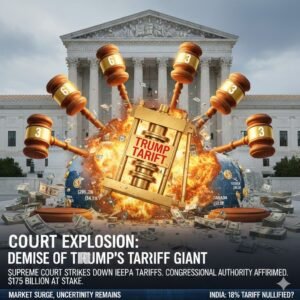
Highlights: In a 6-3 ruling, the U.S. Supreme Court declared the extensive tariffs imposed by President Donald Trump under the IEEPA as illegal. The court stated that the authority to impose tariffs lies with Congress, not the executive branch.
……………………………………………………………………
The Supreme Court of the United States has declared the broad tariffs on imports imposed by President Donald Trump illegal. In a 6-3 majority decision on Friday (20th), the court said that the International Emergency Economic Powers Act (IEEPA) of 1977 does not allow the President to impose such wide-ranging and long-lasting tariffs. This ruling nullifies most tariffs implemented unilaterally after April 2025 and clarifies that such commercial taxes cannot be imposed without Congressional approval.
What did the Court say?
The majority, led by Chief Justice John Roberts, held that the IEEPA is a law designed for specific emergency circumstances, not for implementing a permanent tariff policy. The court upheld the lower court’s decision, which had already described the tariffs as legally baseless. The case began with a petition from companies and 12 U.S. states affected by these tariffs, most of which were Democrat-led.
$175 Billion at Stake
According to experts, this decision could have a massive financial impact. According to estimates by the Penn-Wharton Budget Model, more than $175 billion was recovered from the tariffs imposed under the IEEPA. Now, this amount may have to be returned by the government. The Congressional Budget Office had estimated annual tariff revenue of about $300 billion in the coming years. Following the Supreme Court’s decision, this estimate is now in question.
Which country might have to be refunded how many dollars?
The estimated revenue from potential tariffs on different countries presents an interesting picture. According to the data, the biggest impact is seen on China. It is estimated that approximately $205.2 billion in tariff revenue may have been collected on imports from China.
This is followed by Mexico ($84.1 billion) and Canada ($78.8 billion). India ranks fourth on this list. According to estimates, about $33 billion in tariff revenue might have been obtained from imports from India. This is followed by Japan ($32.3 billion), Germany ($29.9 billion), and Vietnam ($29.8 billion).
South Korea is estimated at $27.9 billion and Taiwan at $17.3 billion. Meanwhile, significant amounts are likely from Italy ($12.9 billion), Thailand ($12.6 billion), Brazil ($12.5 billion), and Switzerland ($12.2 billion). An estimated $9.9 billion in revenue could come from France. Additionally, the ‘Other Countries’ category shows a total of approximately $105.5 billion in potential tariff revenue.
Market Surge, but Uncertainty Remains
Wall Street saw a surge immediately after the decision. However, analysts believe the government may seek other legal avenues to save some tariffs.
Emphasis on Balance of Powers
The Supreme Court clarified that the primary power to set tariff policy lies with Congress. According to foreign trade experts, the original rates from before April could become effective again. FIEO Director General Ajay Sahai said the Trump administration has spoken of a “Plan B.” If an alternative legal basis is not adopted, a return to the old duty structure is certain.
According to Ajay Srivastava, founder of Global Trade Research Analysis, the proposed 18% duty will not apply to approximately 55% of goods exported to the U.S. if the decision is implemented. Smartphones, petroleum products, and medicines may remain tax-exempt as before.
18% Tariff on India
It is noteworthy that Indian exporters were paying an additional 50% duty along with the old duty on exports to the U.S. since September last year. Currently, Indian exports are facing 25% plus the duties applicable before last April. After the trade agreement signing next month, this 25% duty would have decreased to 18%.
The decision could cost Trump dearly
This decision could be heavy for him as midterm elections are to be held in the country this year. Trump had made tariffs the basis of his economic proposals to woo voters, promising that overseas factories would relocate and bring jobs with them.
About the Author