New Delhi | News Wave
( With analysis)
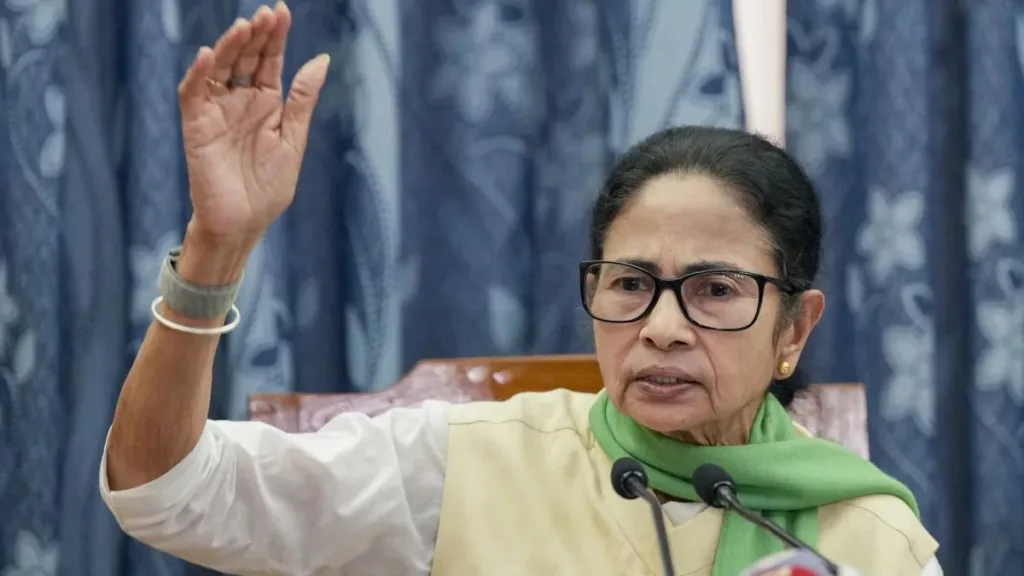
A fresh controversy has erupted over West Bengal Chief Minister Mamata Banerjee’s personal appearance in the Supreme Court to argue a case. A new application has been filed in the apex court challenging her move, stating that it is “not appropriate” for a sitting Chief Minister to appear in court in such a manner.
The plea, filed by Satish Kumar Agarwal, Vice President of the Akhil Bharat Hindu Mahasabha, argues that the Chief Minister’s physical presence could exert a form of “symbolic pressure” on the judiciary.
Key Highlights of the Dispute
Last week, Mamata Banerjee personally appeared before the Supreme Court regarding a petition concerning the Special Interim Revision (SIR) process of the voter list in West Bengal.
State vs. Personal Issue: The application contends that since the matter pertains to state governance and not a personal grievance, the CM should be represented by state-appointed advocates rather than appearing in person.
Constitutional Decorum: The petitioner argued that individuals holding high constitutional offices should avoid personal appearances to maintain the dignity of the court and prevent cases from becoming personalized.
Legal Standing: The plea further questions whether the CM had the right to file a petition under Article 32, as the matter does not involve a violation of her fundamental rights.
“Targeting Bengal,” Claims CM Mamata
During the previous hearing, Mamata Banerjee sought permission to argue the case herself. While Chief Justice Surya Kant advised her to let her counsel lead the arguments, the CM raised serious allegations against the central authorities.
“They are targeting only Bengal by appointing Micro-Observers. Save Democracy. In the first phase, 58 lakh names were removed without any scope for appeal via Form-6. In the second phase, 1.30 crore names were struck off. Why is this system only for West Bengal? They are using these observers like a bulldozer against the people of my state.”
— Mamata Banerjee in Supreme Court
………………………………………………………………….
⚖️ Mamata Banerjee’s Court Appearance: An Analysis
……………………………………….
We can look at this entire incident from three main perspectives:
1. Constitutional Dignity vs. Personal Presence
A crucial question has been raised in the petition filed by the Akhil Bharat Hindu Mahasabha: “Is it right for a Chief Minister to argue their own case in court?”
Symbolic Pressure: According to the petitioners, when a person holding a powerful constitutional position is personally present in court, it can create a form of mental or Symbolic Pressure on the judges.
Formal Process: Generally, high-ranking lawyers (Solicitors/Advocates) represent the State Government. Mamata’s personal appearance has sparked a debate regarding court traditions and ‘protocol.’
2. The SIR and Voter List Dispute
The core issue of this case is the Special Summary Revision (SIR). Mamata Banerjee’s allegations are extremely serious:
According to her, names of lakhs of people in Bengal have been excluded from the voter list.
She has opposed the appointment of “Micro-Observers,” describing it as a move to target Bengal and as being anti-democratic.
3. Political Strategy or Judicial Battle?
This step by Mamata Banerjee can be viewed through two lenses:
Aggressive Strategy: By being personally present in court, she wants to prove that she is ready to fight for the people of her state until the very end.
Constitutional Rights: The Supreme Court will also examine whether this petition is maintainable under Article 32, as this is not a matter of an individual’s fundamental rights but a state-wide issue.
Party Key Argument
Mamata Banerjee “Bengal is being targeted; Save Democracy.”
Satish Kumar (Hindu Mahasabha) “The CM’s presence may put pressure on the dignity of the court.”
Supreme Court (CJI) “Let the lawyers present the arguments.” (In previous hearings)
Conclusion:
The hearing scheduled for tomorrow (February 9) is extremely significant. The Court may not only rule on the voter list dispute but also express its opinion on how appropriate it is for a Chief Minister to personally act as an advocate in court.
Special Information on Article 32
Article 32 is one of the most powerful articles of the Indian Constitution. Dr. B.R. Ambedkar called it the “Heart and Soul of the Constitution.”
🛡️ What is Article 32?
If a citizen’s Fundamental Rights are violated, they can directly approach the Supreme Court. To protect these rights, the Court can issue 5 types of ‘Writs’.
⚠️ Why the controversy in Mamata Banerjee’s case?
The questions raised by the Akhil Bharat Hindu Mahasabha are based on two legal aspects:
Personal vs. Public Interest: Article 32 is generally used for an individual’s own fundamental rights. Here, Mamata Banerjee is speaking about the state’s voter list as a Chief Minister. Petitioners argue this isn’t her “personal” fundamental right.
Alternative Remedy: Usually, such cases should first go to the High Court (under Article 226). A strong reason is required to come directly to the Supreme Court.
Analysis: Is a CM personally acting as an advocate a good sign for democracy?
A Chief Minister advocating or presenting their own case in court is a highly complex and sensitive issue. We can look at this from two viewpoints:
✅ Arguments in Favor (Why is it good for democracy?)
Accountability to the People: When a CM stands in court personally, they send a message that they are ready to fight for their people. This increases public trust in the leader.
Direct Communication: Often, what lawyers cannot say in legal language, a representative of the people can explain more clearly as a social and political issue.
Legal Right: Under Indian law, any person (even if not a lawyer) can present their own side with the court’s permission. This is a mark of personal liberty.
❌ Arguments Against (Why is it a matter of concern?)
Constitutional Dignity: The CM is a high constitutional post. Their presence may create unintended mental pressure on judges, potentially hindering an impartial judicial process.
Institutional Disrespect: There are Advocate Generals and top lawyers to represent the State. If a CM advocates personally, it suggests they lack faith in their own lawyers or the established legal system.
Priority: A CM’s primary job is to govern the state. If they spend time in court, the administration may be affected.
Political Stunt: Often, this is viewed more as a political move to gain public attention rather than a quest for justice.
Deep Analysis: Will Justice be easier or harder to obtain?
From the perspective of judicial process and democratic values, a CM personally advocating is likely to make the process more complicated rather than easier.
Emotion vs. Law: A leader speaks on public emotion and political issues. However, the court runs solely on Evidence and Statutes. Emotional arguments can waste the court’s valuable time.
Questions on Judicial Impartiality: If the court rules in favor of a powerful CM, people might say “Justice was given under the pressure of the post.” If it goes against them, it will be labeled an “insult to the government,” creating a political controversy.
Lack of Professional Expertise: Law is a specialized field. A CM cannot understand the legal loopholes and complexities like a senior lawyer can. This weakens the State’s side.
Final Conclusion: Should the ‘Post’ be bigger in court, or the ‘Book of Law’?
Inside the threshold of the court, only and only the ‘Book of Law’ or the Constitution should be supreme.
Equality before Law (Article 14): Whether a common citizen or a powerful CM, all are equal. If the ‘Post’ is given weight, the foundation of equality crumbles.
The Blindfold of Justice: The Lady of Justice is blindfolded. She doesn’t see who is standing before her, only the facts.
Checks and Balances: The judiciary is the only institution that can control the executive. If a leader shows the influence of their post inside the court, judicial independence is endangered.
Final Thought:
Mamata Banerjee’s presence may be a ‘political message,’ but it is not a healthy sign for ‘judicial process.’ The court is a place for calm logic, not a display of power.
About the Author