By-Jawahar Mishra
…………………………………………………………………….
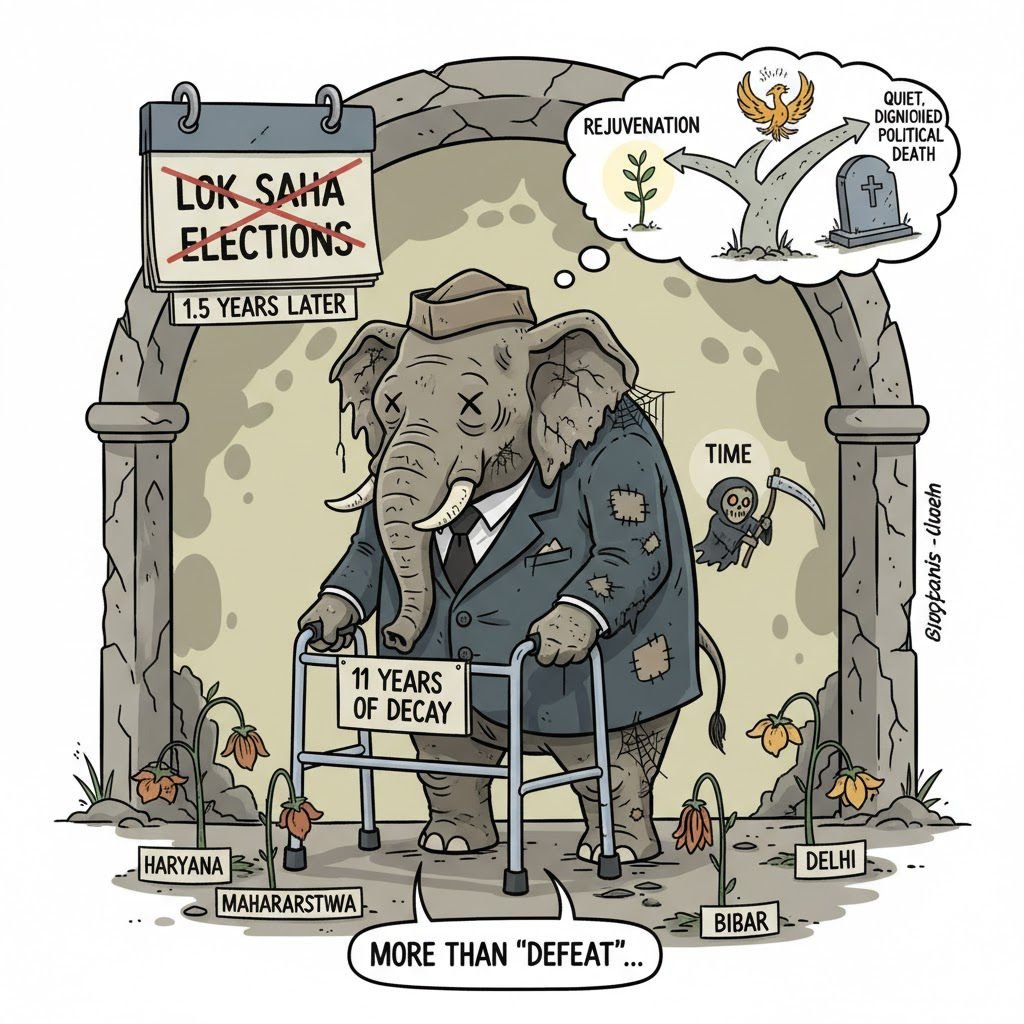
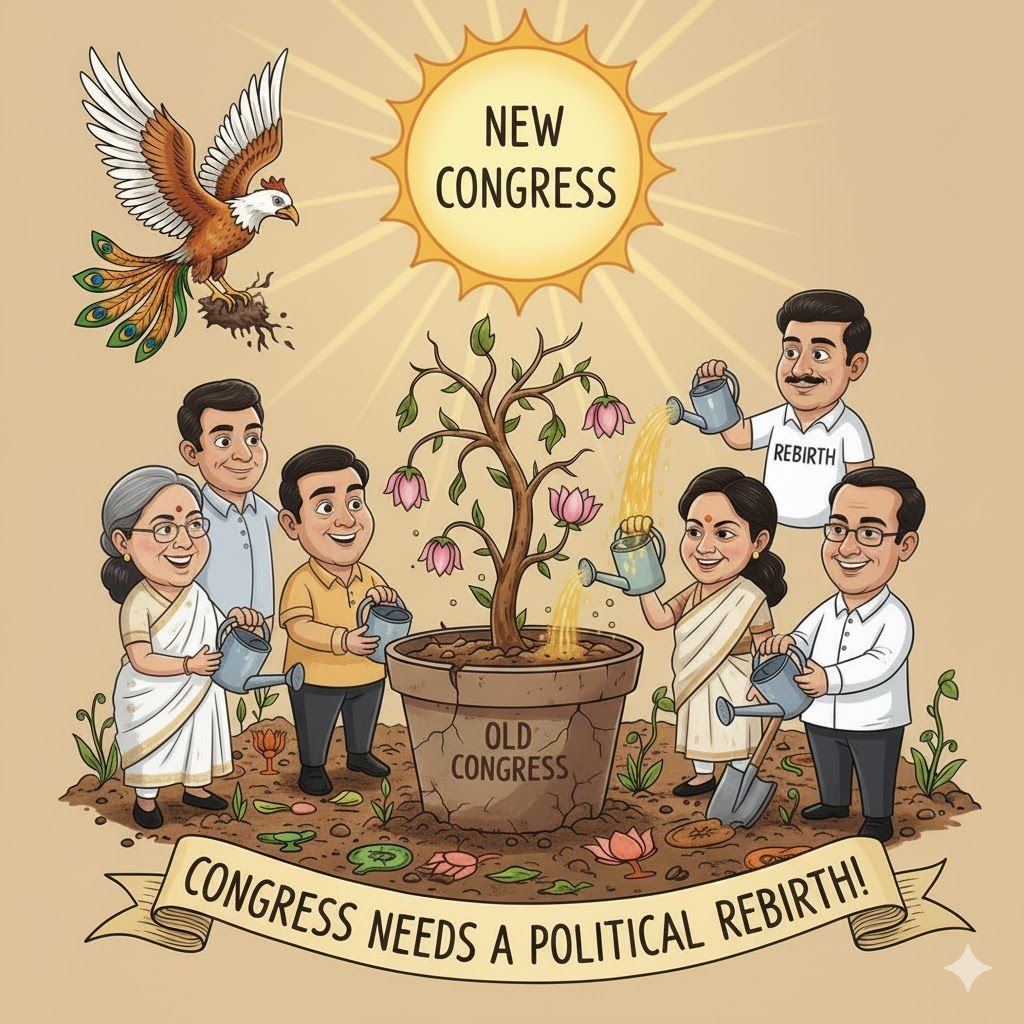
Congress now needs not introspection, but rejuvenation, political rebirth, or a quiet, dignified political demise. It’s been a year and a half since the Lok Sabha elections, and during this time, Congress has lost in Haryana, Maharashtra, Delhi, and now Bihar. Even calling it “defeat” is a mild statement. For eleven years, this party hasn’t just been losing; it’s also been slowly rotting and decaying.
Yet, the Gandhi family has denied reality by appointing elderly Mallikarjun Kharge as the caretaker of ruins. As if the Congress calendar still records the year 2004. In the current fast-paced, competitive world, Rahul Gandhi and his inner circle (if any) are essentially marathon runners—slow, serious, perhaps moral, but completely out of step with the times. This is because the time is for a sprint, while Congress is mired in its own exhausting rhythm.
What happened in Bihar isn’t just a feat of electoral arithmetic or the enduring power of an alliance. This is a testament to the political times and culture that the BJP has mastered and that Congress still fails to grasp. Narendra Modi doesn’t appeal to BJP voters to dwell on the past; he asks them to imagine a future—be it contentious, unequal, and risky. In contrast, Congress still speaks the language of a savior—as if India is waiting for it to come and save it.
There was a rift in the political discourse around Lok Sabha 2024. But rifts don’t automatically become revolutions. They require structure, continuity, and an opposition that knows what future it wants to replace the present with, not just who it wants to remove. This is where the Congress falls short—it lacks a theory, a slogan, or even a bluff for the future.
For a decade, Rahul Gandhi has been presenting himself as the protector of the Indian Republic, the guardian of the Constitution, and the guardian of institutions. Now, however, this generation—the crowd, raised amid data leaks, exam scams, dwindling employment, and a democracy buffered by a weak internet—doesn’t trust protectors. They don’t want watchdogs of the system, nor leaders who repeat the morality of the past. This generation wants choreographers who can harness the clamor of the crowd—who can give direction to an already spinning world.
This generation isn’t simply impressed by honest, principled leaders in white T-shirts. She wants a hero who is seen sweating and toiling on stage, who presents power not as a promise but as a performance, a play. She doesn’t want push-ups done behind closed doors in a gym, but a high-kicking, meme-ready, live-televised warrior, a leader who roars on the center stage of politics.
While in this adrenaline-fueled political market, Congress is still out to sell conscience and morality to a generation trained to buy into the spectacle. Prime Minister Modi, despite all his contradictions, still speaks and communicates with the tension of change. Rahul Gandhi brandishes the Constitution.
The Bihar results made this even more tragically clear. After the youth uprising in Nepal, Rahul Gandhi spoke as if Gen Z had entered Indian politics like a monsoon storm. Suddenly, he seemed to believe that vote theft was the new national anthem of this restless generation. But the truth was different, and that’s why it’s unclear who is advising him.
How many of the young people sitting on hostel verandas in Patna or Purnia, or scrolling through reels at tea stalls, are thinking that this election hinges on an EVM conspiracy? Gen Z assumes that the entire game is pre-rigged.
This generation has grown up in an India where: exam papers get leaked (no big deal), jobs shrink, rents rise, NEET-UG collapses, but what difference does it make? Student suicides are becoming a sadly common occurrence. But who cares? Their politics are shaped by memes, screenshots, leaks, and late-night Discord calls—not speeches delivered in the tone of a school principal.
The Congress doesn’t understand all this, or no one in the Gandhi family does. Neither its old leadership nor its new one. Therefore, it remains an elite club, not a political home. This is why even Tejashwi Yadav hasn’t been able to fully capture this young voter. Gen Z wants progress—but not at the cost of moral panic. It needs language, leadership, and the air of quickly understanding and promising its crumbling world. Gen Z isn’t waiting for a savior. It wants to be understood and its memes.
This is a generation that romanticizes struggle. The children of parents who spent years searching for organic baby food and unadulterated lentils and rice are now scrolling through politics in a universe filled with the allure of populism and mild authoritarianism.
If Rahul Gandhi truly wants to speak to this generation, he must adopt the internet’s most honest principle: DYOR—Do Your Own Research. That is, the youth need to learn from them, not be told. Politics today is not about reading the pulse of the nation, but about capturing the mood of a generation—a generation that has replaced ideological manifestos with moodboards. Manifestos didn’t achieve anything in Bihar, but yes, the buzz around instant accounts has become all the rage. The young crowd dreams of seeing leaders embracing people in the White House, walking the corridors of the G7, not slogging through the mud in paddy fields.
So Rahul Gandhi needs to get rid of his advisors who whisper about everything: “Democracy is in danger, or will caste census and jobs solve the problem?” The harsh truth is that very few young Indians worry about democracy before going to bed. They worry about whether their reel will trend or not, whether their bank account will allow them to go to Bangkok to create content. This is their emergency. Therefore, waving the red Constitution book, the tone of vote-stealing, the caste census, and the politics of farm photo-ops means a missed opportunity. A betrayal. The new generation is breathing toxic air, watching the value of degrees plummet, and seeing hope downgraded in real time. Despite this, they need a leader who speaks in a language that doesn’t bore them.
Clearly, young people aren’t looking for a savior who will bring them good days, but rather a story they can grow to love, trend, and reel about.
So, back to the beginning. In this climate of restless politics, Rahul Gandhi shouldn’t display his own restlessness. If he wants to give the Congress a face, a new identity, he now faces two honest choices: step aside and hand over the reins to someone who understands the pulse of the times. Or, he should disband the old advisory board and forge a political vision with a solid theory of the future. Because politics is ultimately that ruthless: either you convince the country that your opponent can’t bring about good days, or you give way to someone else—who might.
About the Author