…………………………………………………………………….
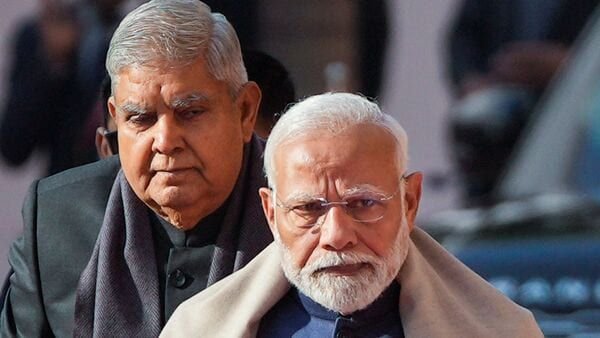
Those who clashed with Prime Minister Narendra Modi have had to leave their posts.It has cost them dearly. In fact, for the first time in the history of Indian democracy, a Vice President has resigned from his post before completing his term. Similarly, in the last 11 years, 7 people, including former Vice President Jagdeep Dhankar, have resigned from their posts after facing Prime Minister Narendra Modi.
One thing is common among those who resigned before the end of their term. All of them did not agree with the Modi government at the Centre on some issue or the other. Many times this was made public. In some cases, it could not be made public. Apart from Dhankar, 6 others had also faced the Modi government earlier.
Former RBI Governor Raghuram Rajan
Economist and academic Raghuram Rajan, handpicked by Manmohan Singh in the last year of the UPA-II government, declined a second term in September 2016 and returned to his teaching job at the University of Chicago. A former chief economist at the International Monetary Fund (IMF), Rajan predicted the 2008 global financial crisis.
Rajan had disagreed with the government over demonetisation and the electoral bond scheme, which were also dismissed by the Supreme Court last year. At the time, Union Commerce Minister Nirmala Sitharaman publicly criticised and refuted one of Rajan’s comments on India’s growth.
Former RBI Governor Urjit Patel
Urjit Patel announced his resignation in December 2018, days before a crucial RBI board meeting, citing “personal reasons”. Ever since he resigned nearly seven years ago, there has been a huge debate about why he left before completing his first term.
Urjit Patel took over as the head of India’s central bank after Raghuram Rajan and weathered the storm of demonetisation. He is said to have clashed with the Narendra Modi government on several occasions. Patel’s resignation was a major blow not only to investors but also to the government.
Several media reports have cited differences between him and the government as one of the reasons for Urjit’s resignation. The government was under pressure to release some of its 3.6 trillion rupees ($48.73 billion) in reserves to the central bank to help it reduce its fiscal deficit.
The central government is said to have threatened to invoke the provisions of Section 7 of the RBI Act, forcing the RBI to withdraw Rs 3 lakh crore from the reserves to cover the losses from demonetisation.
After Urjit’s resignation, it was also speculated that the Modi government was pushing for electoral bonds, which Patel’s predecessor Rajan had also opposed. Patel had also questioned the late Union Finance Minister Arun Jaitley on the issue of bonds by any bank other than the RBI.
Former RBI Deputy Governor Viral Acharya
Viral Acharya made headlines in October 2018 when he delivered a speech on the need to ensure the independence of the RBI, and warned that any move to reduce the RBI’s autonomy could lead to “potential disaster”.
Acharya’s comments came at a time when differences were growing between the Narendra Modi government and India’s central bank, which ultimately led to the resignation of the then RBI Governor Urjit Patel. Acharya resigned a few weeks before the RBI’s Monetary Policy Committee meeting.
Former RBI Deputy Governor Viral Acharya
Acharya, who headed the RBI’s monetary policy department, had a falling out with the then governor Shaktikanta Das over the government’s handling of public finances and the Modi government’s approach to estimating the fiscal deficit. A month before he resigned on “personal grounds”, Acharya had reportedly had a falling out with Das at a meeting of the Monetary Policy Committee.
Former CEO Arvind Subramanian
Chief Economic Advisor Arvind Subramanian had informed Arun Jaitley via video-conferencing in 2018 about his decision to return to the US to attend a family function on the birth of his grandson. He was ill at the time. Subramanian, who was appointed as the CEO for a three-year term in October 2014, had been asked by Jaitley to stay in the US.
Like Raghuram Rajan, he has come under severe criticism from RSS-affiliated Swadeshi Jagran Manch and Subramanian Swamy for his support for privatisations, including Air India. Once, Subramanian faced public criticism for his support for Washington’s intellectual property rights. Then, Union Finance Minister Jaitley had to intervene.
Former EC Ashok Lhosa and Arun Goel
A few days before the announcement of the 2024 Lok Sabha election schedule, Election Commissioner Arun Goel submitted his resignation. After Goel’s departure, only the then Chief Election Commissioner Rajiv Kumar was left on the Central Election Panel. Why Goel, a 1985-batch Punjab cadre IAS officer, resigned a day before his visit to West Bengal for a pre-poll survey, remains a question!
If Goel had completed his full five-year term, he would have succeeded Jnanesh Kumar as the Chief Election Commissioner. Arun Goel’s resignation was reportedly due to differences with the then Chief Election Commissioner Rajiv Kumar.
Election Commissioner Ashok Lavasa resigned after issuing several dissenting opinions on allegations of campaign violations by Modi and Shah during the 2019 Lok Sabha elections. Later, an Income Tax probe was launched against five members of his family. It turns out that he was one of the people targeted by the Pegasus spyware.
About the Author