By- Jawahar Mishra
Chief Editor
……………………………………………………………………….
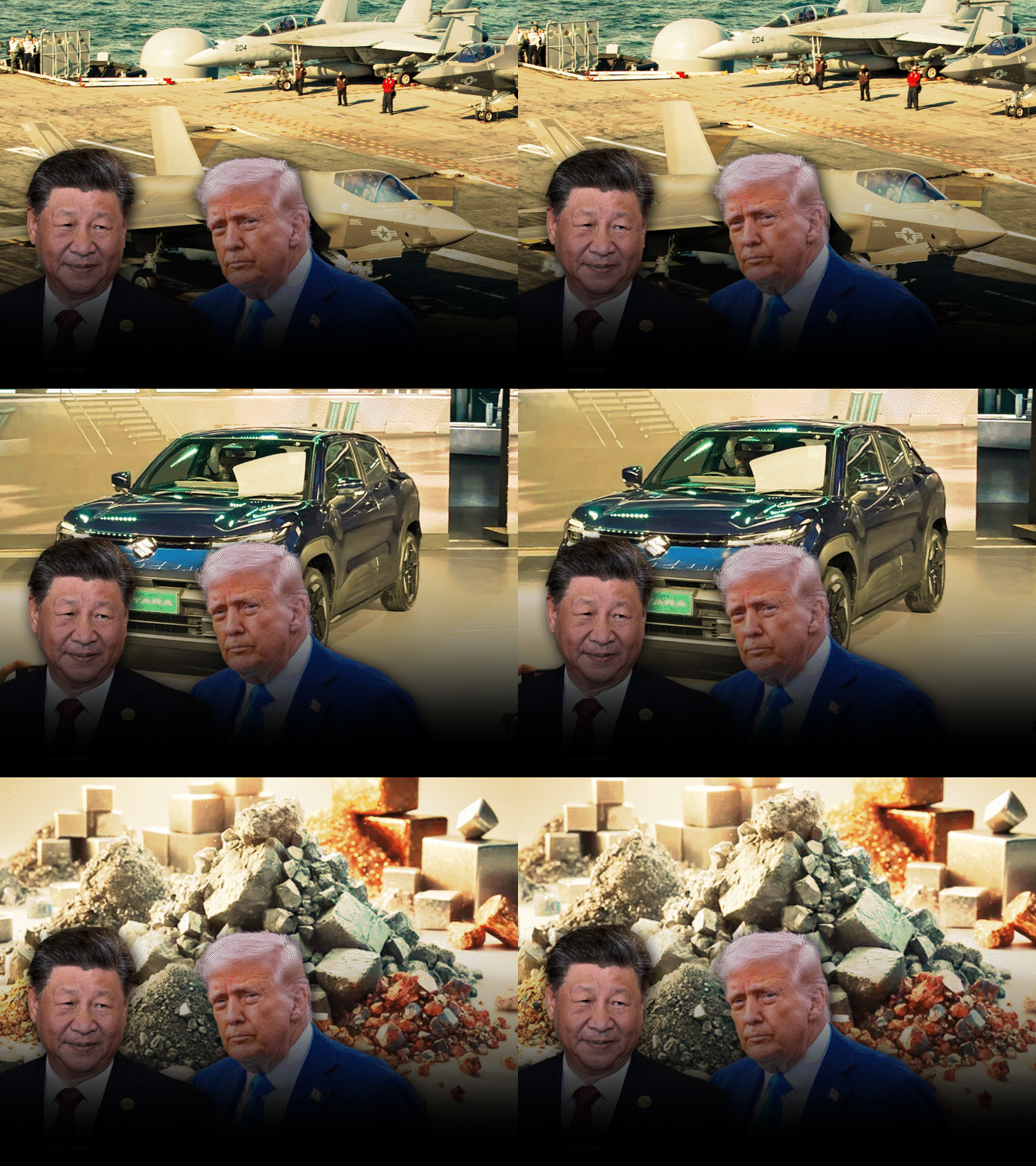
Did you know that everything from your smartphone to fighter jets has one thing in common? Yes, that thing is rare earth materials. These tiny metallic elements have become the backbone of the world’s technology and defense sectors. This is also the reason behind the US’s announcement of 100% tariffs on China. Let’s learn more about it.
China and the US face off over essentials for everything from phones to fighter jets
China on Thursday increased restrictions on its rare earth materials. This prompted US President Donald Trump to threaten economic retaliation and hint that he would cancel a meeting with Chinese President Xi Jinping during his upcoming trip to Asia. The US has also threatened to impose an additional 100% tariff on China starting November 1st, in addition to the current 30% tariff.
China’s monopoly is no longer acceptable to the US
The US and China have been at loggerheads over rare earth materials since before the current Trump administration. China has established near-total control over such minerals over the years as part of its comprehensive industrial policy. China’s recent restrictions on rare earth materials are also seen as a response to Trump’s tariffs on Chinese goods announced in April. Following the trade truce agreed in Geneva, US officials had hoped China would ease export restrictions on those minerals. However, this did not happen.
What are rare earth materials?
Rare earth elements, or rare earth materials, include a total of 17 metallic elements, such as scandium, yttrium, and lanthanides. Although the name suggests these elements are rare, the truth is that these elements are found throughout the Earth’s crust. They are even more abundant than gold. So why are they called rare earth materials? Where is the problem? Mining and processing these elements is extremely difficult, expensive, and harmful to the environment.
Where are rare earth materials used?
From smartphones to wind turbines, LED lights and flat-screen TVs, to even everyday technologies, rare earth materials are essential for everything. They are crucial for electric vehicle batteries, MRI scanners, and cancer treatments. Even the US military cannot function without rare earth materials. According to a CSIS 2025 research note, these are used in F-35 fighter jets, submarines, lasers, satellites, Tomahawk missiles, and more.
Where do rare earth materials come from?
According to the International Energy Agency, 61 percent of the production of rare earth materials from mining comes from China. Furthermore, if the processing stage of rare earth materials is also included, China alone controls 92% of global production.
Why is there a dispute between the US and China over this ?
There are two types of rare earth materials. They are classified based on their atomic weight—heavy and light. Heavy rare earths are relatively rare, and the US doesn’t have the capability to separate them after mining. “Until earlier this year, all the heavy rare earth materials we mined in California had to be sent to China for separation,” Gracelyn Baskaran, director of the Critical Minerals Security Program at the Center for Strategic and International Studies, told CNN. However, the Trump administration’s announcement of steep tariffs on China in April derailed this process. “China has demonstrated its intent to weaponize the US’s dependence on China for separation of rare earth materials,” she said. According to Baskaran, the US has one operating rare earth materials mine in California.
What role do rare earth materials play in the trade war?
In the ongoing trade war between Washington and Beijing, China is leveraging its influence on rare earth materials. China’s recent restrictions on these metals come as Xi and Trump are scheduled to meet at the APEC summit in South Korea later this month. In its most recent move, China has added five rare earth materials—holmium, erbium, thulium, europium, ytterbium, and related magnets and materials—to its existing control list. Their export will now require a license. This move brings the total number of banned rare earth elements to 12. Licenses will also be required for the export of rare earth manufacturing technologies from China.
70% of US imports by 2023 came from China.
This isn’t the first time China’s restrictions on rare earth minerals have angered Trump. In June, Trump stated on Truth Social that China had violated the trade agreement because Beijing maintained its export controls on seven rare earth minerals and related products. These controls could have a major impact, as the US is heavily dependent on China for rare earth elements. According to a report by the US Geological Survey, 70% of US imports of rare earth compounds and metals between 2020 and 2023 came from China. But China’s new restrictions have once again brought the world’s two largest powers face-to-face.
Trump’s blunt statement
Xi Jinping forced us to compete economically
Trump wrote on Truth Social Friday, “After the hostile ‘order’ China has issued, as President of the United States, I will be forced to counter his (Xi Xi’s) actions economically.” He said, “Every element that China has monopolized, we have twice as much of.”
About the Author