
Highlights – Vegetarianism is declining in India, while veganism is rapidly increasing in the West. Changing lifestyles, health, and environmental factors are driving this shift.
Vegetarianism in India
Traditional eating habits have changed significantly these days. The rise of online food delivery and hotels and restaurants, along with the increasing daily busyness of people, has transformed the face of kitchens. There was a time when India was known worldwide as the “land of vegetarians.” But today, the picture seems to be changing. The Western world, once considered a non-vegetarian civilization, is rapidly moving towards vegetarianism and veganism. Meanwhile, in India, whose cultural identity was based on vegetarianism, the trend of meat eating is increasing. The question arises: is the tide turning in terms of dietary changes?
Changing Trends in the West and the Growing Popularity of Plant-Based Diets
In countries like the United States and Europe, vegetarianism is no longer a religious or traditional obligation, but rather a conscious issue. Sensitivity to health, the environment, and animal rights has accelerated this change. Westerners who once mocked Indians, saying, “They would rather starve than eat cows,” are now themselves distancing themselves from cows, sheep, and chickens.
American professor Melanie Joy says, “I stopped eating meat not because it tasted bad, but because I didn’t want to kill any living being.” This thinking has become the ideology of millions in Europe and America. Supermarkets are now filled with plant-based alternatives to meat or dairy products. Soy milk, almond milk, vegan cheese, and meat-like alternatives like veggie burgers or tofu sausages are available. This movement has grown so much that World Vegetarian Day is celebrated every year in the West on October 1st.
Laboratory Meat – A New Technological Revolution
For those who cannot give up meat because of its taste, science has opened up a new avenue: “Cultured Meat.” This is real meat, grown from cells in a laboratory, without the slaughter of any animal. In 2013, Dutch scientist Mark Post’s team first created burger meat from cow cells in a laboratory. Several companies in the US subsequently followed suit. In 2023, the US Department of Agriculture authorized two companies to sell “cell-cultured chicken meat” for the first time. Italy, meanwhile, banned its sale, while the European Union is still in the process of approving it. Its aim is to reduce the environmental burden and ethical controversies posed by conventional animal husbandry.
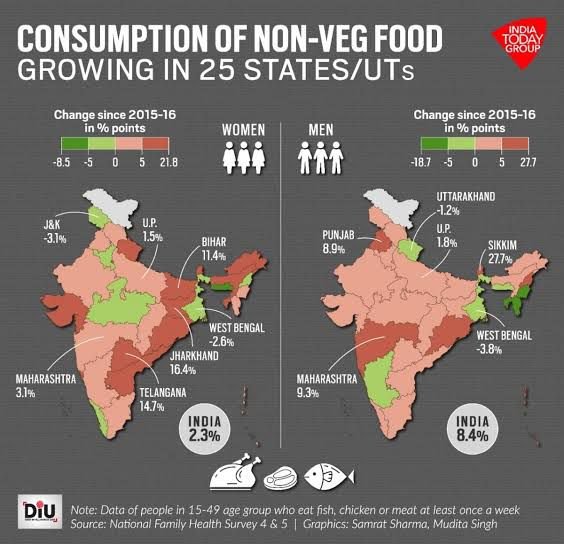
India is experiencing a reverse trend: vegetarianism is declining, non-vegetarianism is increasing.
India has been considered the world’s largest vegetarian nation for centuries, but this tradition has been weakening in the last few decades. In 2021, only 29.5 percent of India’s population, approximately 270 million people, remained vegetarian. Meanwhile, approximately 9 percent of Indians (approximately 120 million) are now vegans, meaning they abstain from milk or any animal products. Currently, according to various surveys, the number of vegetarians in India is estimated to be between 25 and 38 percent. Most of these people are lacto-vegetarians (vegetarians who consume dairy products). Strict vegans remain a minority. This decline in India has been due to several factors. The most significant are improved economic conditions and urbanization. As incomes have increased, so has dietary diversity. Meat, once considered a luxury, has now become commonplace. Fast food culture, the growing popularity of hotels and restaurants, and the influence of foreign lifestyles are also accelerating this change.
Now even Brahmins are becoming non-vegetarians – a rift in traditions is emerging.
Another interesting social aspect is that even communities that were traditionally considered vegetarian, such as Brahmins, Jains, and Vaishnavs, have now seen an increase in meat consumption. Many young people say that eating meat is no longer a taboo. Changing lifestyles, migration, and modern food culture have erased this hesitation. Nevertheless, India’s religious and cultural roots are so strong that complete meat-eating cannot ever become mainstream in society. In villages and small towns, a large number of families still follow traditional vegetarianism.
Why the surge in vegetarianism in Western countries?
While meat consumption is increasing in India, people in the West are giving up meat for health, environmental, and ethical reasons. Studies show that vegetarians have significantly lower rates of heart disease, obesity, and cancer than non-vegetarians. Furthermore, environmental considerations are also involved. Approximately 14% of global methane emissions come from the animal husbandry industry. So, when someone gives up meat, they not only save a life but also provide relief to the planet.
About the Author